
Recruitment becomes difficult when applications arrive through different channels, candidate details remain scattered across spreadsheets, interview feedback is delayed and hiring managers cannot identify where vacancies are getting stuck. Recruiters may spend more time chasing updates than evaluating candidates or communicating with them.
The solution is not simply to process applications faster. Businesses need a consistent hiring workflow that makes responsibilities clear, reduces administrative work and preserves appropriate human judgement throughout recruitment.
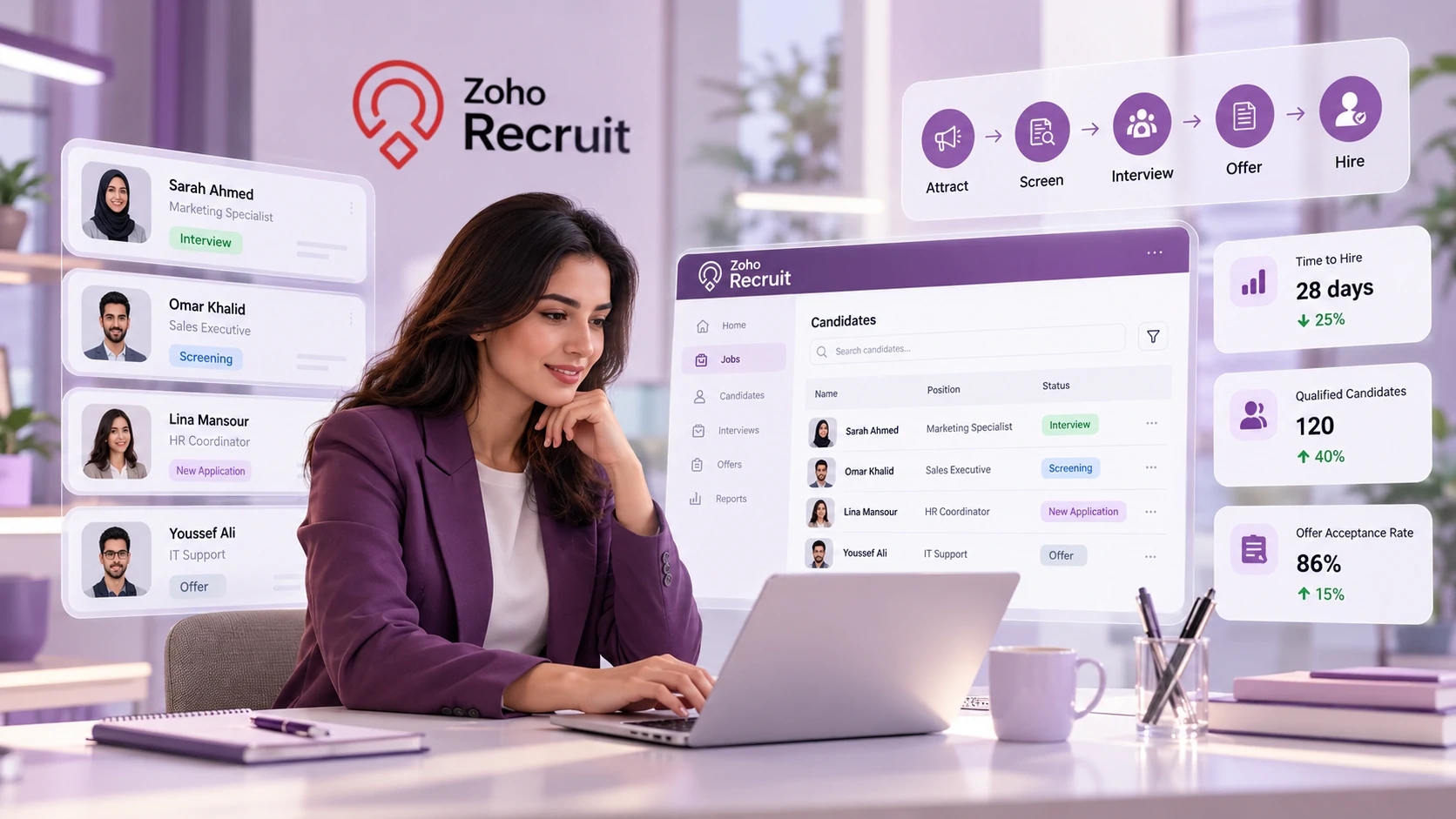
Zoho Recruit is an applicant tracking system that helps organisations manage vacancies, organise candidate records, coordinate interviews and automate repetitive recruitment tasks. It creates a structured process from application to hiring decision, with workflows, communication templates, evaluations and reporting.
Why do traditional recruitment processes create delays?
A recruiter may receive applications by email, through a careers page, from job boards and from employee referrals. Without a central system, the same candidate can appear in several places, interview notes may be stored separately and hiring managers may have different interpretations of candidate status.
Common problems include delayed screening, inconsistent evaluation criteria, missing application acknowledgements, duplicated administrative work and unclear offer approvals.
As recruitment volumes increase, these weaknesses become more visible. Even an experienced recruitment team can struggle to maintain accurate records without an agreed process.
What is Zoho Recruit?
Zoho Recruit is a cloud recruitment platform and applicant tracking system designed for managing job openings, candidates, recruitment activities and hiring workflows.
It supports recruitment teams through candidate databases, résumé parsing, job publishing options, interview management, automated workflows, assessments, communication templates and recruitment analytics. Individual capabilities can depend on the selected edition, integration and configuration.
Centralised candidate records
Store candidate details, applications, communications and recruitment activity in a structured environment instead of separate spreadsheets and inboxes.
Visible hiring pipelines
Understand which vacancies are open, where applicants are positioned and which hiring stage requires action.
Consistent interviews
Coordinate interview schedules and use defined evaluation criteria to make feedback easier to compare.
Recruitment automation
Reduce repetitive notifications, assignments, reminders and updates through carefully configured workflow rules.
How does recruitment automation work?
Recruitment automation uses predefined conditions to perform routine actions within the hiring process. For example, receiving a new application can trigger an acknowledgement message, while moving a candidate to an interview stage can create a task or send a notification when the relevant workflow is configured.
Automation does not guarantee that a candidate is suitable. Its main purpose is to handle predictable administration, maintain consistent communication and help recruiters focus on assessment and decisions.
Which recruitment tasks should be automated first?
Start with actions that follow predictable rules and have low risk when properly tested. These tend to deliver administrative relief without placing critical hiring decisions entirely in an automated process.
| Activity | Recommended approach | Human responsibility |
|---|---|---|
| Application acknowledgement | Use an approved email template and trigger. | Ensure wording and expectations are accurate. |
| Candidate assignment | Route applications according to job ownership. | Review workload and exceptions. |
| Interview reminders | Configure reminders for scheduled interviews. | Handle rescheduling and special requests. |
| Candidate assessment | Use structured questionnaires and scorecards. | Evaluate context, evidence and job requirements. |
| Final hiring decision | Maintain defined approval checkpoints. | Keep accountable human decision makers. |
Choose three repetitive recruitment tasks for the first automation phase: application acknowledgements, internal assignment notifications and interview reminders. Test them with a small recruitment team before adding more complex workflows, approvals or integrations.
How do candidate pipelines improve hiring visibility?
A hiring pipeline shows the progress of candidates through recruitment stages. A useful structure might include application received, initial review, screening, interview, decision, offer and final outcome. Exact stages should reflect the organisation’s recruitment model.
Each stage should answer three questions: who owns the next action, what evidence is required, and what event moves the candidate forward?
For example, an interview stage should not be considered complete simply because the interview occurred. The team may also require interviewer feedback, a scorecard and hiring manager review before changing the candidate’s status.
How can Zoho Recruit improve interview coordination?
Interview delays often happen because recruiters, hiring managers and candidates rely on separate conversations to agree on times and record feedback. Zoho Recruit supports interview scheduling and structured evaluation so that interview activity can remain associated with the candidate record.
Recruitment teams can also use scorecards to assess candidates against job-related criteria. These should be created for each role rather than relying on a generic evaluation template for every vacancy.
Before the interview
Confirm the role requirements, interview participants, assessment criteria and candidate instructions.
During the interview
Ask consistent job-related questions and document evidence against the agreed evaluation criteria.
After the interview
Collect feedback promptly, document outstanding questions and assign the next action.
Before the decision
Review the evidence, discuss material differences and follow the approved hiring process.
Can AI make recruitment decisions automatically?
AI can assist with selected recruitment activities, but employers should not treat automated recommendations as conclusive hiring decisions. Candidate suitability requires job-related evidence, appropriate review and safeguards against unfair or inaccurate assessments.
Zoho Recruit provides AI-related capabilities, with features and availability changing across editions and releases. These tools may support information retrieval, screening activities or recruiter productivity. However, businesses should verify precisely which capabilities are available in their account before designing a dependent workflow.
Recruiters should also be careful when handling candidate information. CVs and interview records may contain sensitive personal data. Access permissions, retention periods, consent where necessary and applicable privacy obligations should be considered before enabling integrations or automation.
Common recruitment automation mistakes
Automating an unclear process
If recruiters disagree about screening stages or ownership, automation can repeat the inconsistency at scale.
Using unsuitable scorecards
A generic assessment for unrelated positions can overlook the skills and evidence that matter for a specific role.
Sending excessive messages
Duplicated reminders and poorly timed automated messages can create confusion for candidates.
Ignoring candidate privacy
Unrestricted access or retaining records unnecessarily creates avoidable data governance risks.
What recruitment metrics should HR teams track?
Recruitment reporting should explain where opportunities for improvement exist. Counting applicants alone does not show whether the hiring process is working effectively.
| Metric | What it measures | How to interpret it |
|---|---|---|
| Time to fill | Time between vacancy opening and filling the role. | Identify slow approvals or long sourcing periods. |
| Time to hire | Time between a defined candidate starting point and acceptance. | Use one consistent definition across reports. |
| Source effectiveness | Progress and outcomes from recruitment channels. | Compare qualified applicants, not just total volume. |
| Interview progression | Movement from interview to subsequent stages. | Review expectations and assessment quality. |
| Offer acceptance rate | Accepted offers as a share of eligible offers. | Investigate compensation or process concerns. |
Zoho Recruit vs Zoho People: what is the difference?
Zoho Recruit focuses on the recruitment lifecycle: vacancies, candidate sourcing, applications, screening, interviews and hiring activities.
Zoho People focuses mainly on employee information and operational HR processes, including leave, attendance, approvals and employee self service.
The distinction becomes important after a candidate accepts an offer. Recruiters should confirm which information needs to move into the employee management process, who validates it and which integration options are supported by the organisation’s configuration.
Related HR articles from Tech Wave
Zoho People for HR Management
Explore how employee records, attendance, leave and HR approvals can be organised after recruitment is completed.
Explore Tech Wave Blogs
Discover more practical guides on business software, implementation workflows and digital operations.
What should businesses prepare before implementing Zoho Recruit?
- Agree on vacancy request and approval procedures.
- Document hiring stages and responsible employees.
- Identify required candidate fields and job-related assessment criteria.
- Review careers page and job posting requirements.
- Define candidate communication templates and approval steps.
- Set data access, privacy and retention requirements.
- Identify handover requirements for Zoho People or another HR system.
- Choose measurable indicators for the initial recruitment pilot.
For example, a growing business could pilot Zoho Recruit with one department and two vacancies. The team could configure its pipeline, import only appropriate existing candidate records, test acknowledgement emails, conduct interviews and verify reports before expanding the rollout. This is an illustrative implementation scenario, not a reported client outcome.
How does Tech Wave approach recruitment implementation?
Tech Wave provides software consultation and implementation services. Its Zoho Recruit offering covers recruitment discovery, pipeline configuration, workflows, interview management, reporting and the transition towards HR systems.
An implementation can begin with consultation to clarify hiring responsibilities and system requirements, followed by configuration and deployment, user training and ongoing support.
Process design and digital workflows
Recruitment transformation also depends on clear forms, permissions, information architecture and user journeys. Tech Wave’s case study portfolio illustrates its broader digital project experience. These projects should not be interpreted as confirmed Zoho Recruit deployments unless individually documented as such.
Frequently Asked Questions
What is Zoho Recruit used for?
Zoho Recruit is used to manage job openings, candidate records, applications, interviews, recruitment workflows and related hiring activities.
Does Zoho Recruit include an ATS?
Yes. Its applicant tracking functionality helps teams organise applications and move candidates through defined recruitment stages.
Can Zoho Recruit automate emails?
Yes. Email templates and workflow rules can support acknowledgements, notifications and other defined candidate communications.
Does Zoho Recruit support interviews?
Yes. It supports interview scheduling and structured evaluation, with specific options depending on the edition and configuration.
Can Zoho Recruit work with Zoho People?
The products support different stages of the employee lifecycle. Relevant handover and integration options should be confirmed during implementation.
Should hiring decisions be fully automated?
No. Automated workflows should support administration and consistent assessments, while accountable people review job-related evidence and make hiring decisions.
Build a more organised hiring process
Recruitment automation delivers practical value when teams know which stages require human judgement and which tasks can follow consistent rules. With a defined pipeline, clear accountability, structured interviews and useful reporting, organisations can reduce avoidable administration and give candidates a more predictable experience.
Improve Your Hiring Workflow
Plan a structured recruitment process with Zoho Recruit and Tech Wave.
Contact Tech Wave